
“But our citizenship is in heaven”
–Philippians 3:20
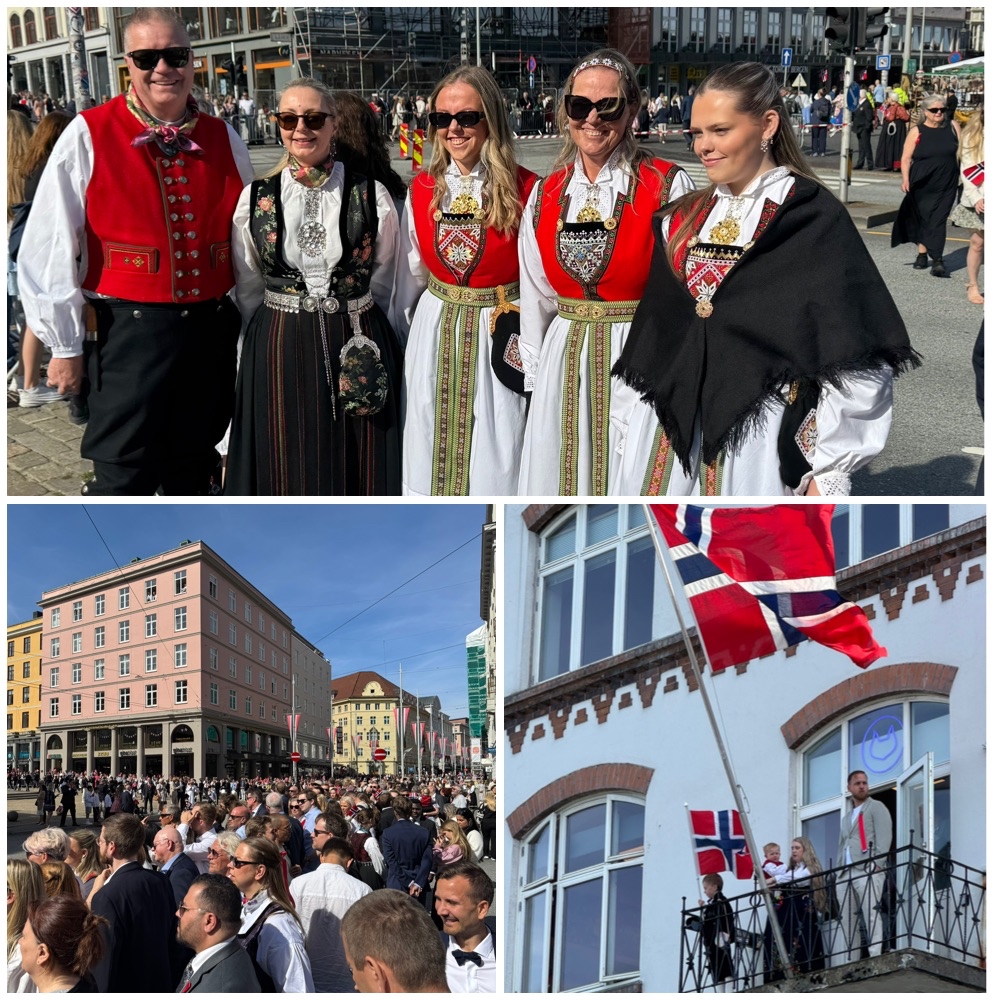
As part of a recent vacation Lori and I were in Norway on its National Day. Each year on May 17, the people of that land commemorate the signing of the Norwegian Constitution in 1814, marking its independence from Denmark and Sweden. Think of it as the equivalent of the Fourth of July for the United States. Despite my diligence in planning carefully for the trip, our being in Norway on that day was purely coincidental. It turned out to be a highlight of our Scandinavian journey.
National Day begins with a huge breakfast in homes as family and friends gather. Adults dress in bunads, bright attire that reveal what region of Norway is their ancestral home. Weddings are the only other occasion those clothes are worn. New graduates hand out small cards with a joke written on it. Unfortunately, we never found one of those students. A father told me his daughter just graduated, but had too much fun the night before and was sleeping in! Young men dress in business suits while people of all ages line the street for parades and drum corps that last for hours.
Given all that fun, when ready to head back to our hotel it took us a while to cross a downtown street that wasn’t blocked with celebrants. As we had headed out that morning to see the festivities, the hotel clerk said “Happy 17th!” Upon returning hours later, we were struck by the fervor of that day and honored to have seen it.
I thought of that experience as I began to ponder the character trait before us this week: citizenship. In a few days, Americans will mark the 249th birthday of our country. Communities large and small will mark the occasion with fireworks and parades, cook-outs and speeches. Such observances are part of what it means to be a citizen, but clearly only scratch the surface.
If you were to do a web search on “The Bible and Citizenship,” you would find a wide range of responses. When posed the question of whether or not faithful Jews should pay the temple tax Jesus said “Give to the emperor the things that are the emperor’s…and to God the things that are God’s.” (Matthew 22:26). Paul urged us to pray for our leaders (1 Timothy 2:2) and pay what authorities require. “Taxes to whom taxes are due,” he said “revenue to whom revenue is due, honor to whom honor is due.” (Romans 13:7)
Of course, the ancients understood that the relationship to power is not always easy. Jesus’ death at the order of government officials demonstrated that peril in a painful way. Yet King Solomon spoke to the same challenge centuries before in writing “When the righteous are in authority, the people rejoice; but when the wicked rule, the people groan.” (Proverbs 29:2) Peter named the potential conflict for people of faith when Jewish leaders tried to stop him from teaching about Jesus. “We must obey God,” he said “rather than any human authority,” (Acts 5:29) And then there is the comment made by Paul to the people of ancient Philippi.
Most of those who first heard his letter were citizens of that province and of Rome. It’s likely some were slaves, too, meaning they had no claim to the protections afforded residents. Yet to all who heard those words then and now, Paul says “But our citizenship is in heaven, and it is from there that we are expecting a Savior, the Lord Jesus Christ.” (Philippians 3:20) Taken as a whole, Scripture speaks of a kind of dual citizenship for believers–a temporal one to earthly authority, but an ultimate one to God.
With that Biblical overview and an impending national celebration I have a few questions. What does citizenship mean to you? What part of that relationship as an American or as a citizen of another country, do you cherish most? What are the moments you feel tension between those two realms and how do you handle that disconnect? I’d welcome your thoughts in the comment section of this blog.
Yet to citizens of the United States reading this post, let me be the first to say “Happy 4th!” To natives of the western-most part of Scandinavia let me offer a belated “Happy 17th!” And to all of you, I encourage an ongoing time of celebration for your citizenship in the realm beyond all human borders.
Eternal Sovereign, thank you for the blessings we already enjoy as future citizens of heaven. Help us to be the kind of citizen now that appropriately respects human authority while always giving ultimate allegiance to you. Amen.
5 responses to “A Dual Citizenship”
JOHN, I feel blessed every day that the Lord is allowing me to be a citizen of the greatest country on the Earth. I cherish our freedom as much as anything, but I am constantly reminded that freedom is not free. We must be forever diligent to protect our freedom.
So true, Marv. I hope you have a wonderful 4th!
John, Ruth Santana Grace quoted Amanda Gorman’s, The Hill We Climb yesterday and it reminded me of the best we are and are called to be as Americans. It’s worth a read (or reread) on this Fourth of July weekend. Thanks for the reminder.
Great idea, Phil. I’ll check it out!
Proverbs 29:2 Thank you! Reminds us that human nature hasn’t changed a heck of a lot, in over 2000 years