
“The LORD revealed himself to Samuel
by the word of the LORD. And the
word of Samuel came to all Israel.”
–1 Samuel 3:21-4:1
One day many years ago, I was sitting in a preaching class of students in their last year of seminary. Each of them, including me, was about to graduate and begin ordained ministry, which meant that most of them, again including me, were chomping at the bit to get on with it. To get out of school and start serving in a church.
Preaching classes are an odd experience. You write the sermon with a particular congregation in mind, but then you deliver it in a room with 10-12 classmates and one or two professors. Once the sermon ends, the preacher has a chance to speak about how she/he felt about it, the professor makes a few comments and occasionally other students as well. It’s good practice, but clearly not the same as being present with a worshiping community.
At any rate, on this particular day, a student delivered a sermon on a text and subject that I’ve long since forgotten. Yet in the discussion afterwards, he made a comment I still remember nearly forty years since my graduation. “When I preach,” he remarked “I believe that I’m speaking the Word of God and the words of God.” “What do you mean?” a classmate asked. He answered “I mean that the words I speak are the very ones God would have used. That I’m not just offering an interpretation of the Word of God, but God’s own words.” With that reply, there was both laughter and dismay in the room. Others pressed him on the bold claim but he would not back down.
I wonder what became of that classmate, for such a claim not only requires powerful self-confidence, but ensures there’s little discussion by the congregation after a sermon. After all, what chance is there for differing views if the one offering the message claims to be speaking the literal words of God? A leader from ancient Israel modeled a better way.
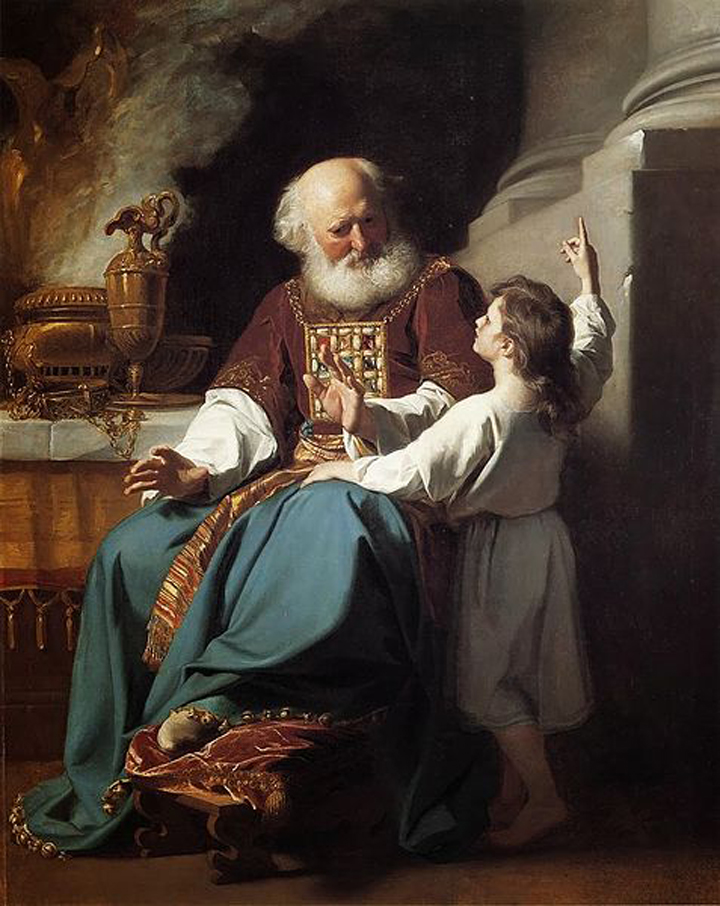
Samuel grew up to be a trusted prophet of God. He had been placed in the service of an old priest named Eli. There is a wonderful scene found in the third chapter of First Samuel when the boy hears a voice in the night on three different occasions. After the first two times he goes to awaken the old man asking what is needed. After the second moment of confusion, Eli tells him that it must be God speaking to the boy and instructing him as to how he should reply. The artwork accompanying this post is John Singleton Copley’s depiction of that happening.
On the third time of hearing his name called out in the middle of the night, Samuel responds “Speak, Lord, for your servant is listening.” Thus began a pattern that continued as the boy became a man; of God speaking to Samuel and that prophet delivering a message to the people. “The LORD continued to appear at Shiloh, for the LORD himself revealed himself to Samuel at Shiloh by the word of the LORD. And the word of Samuel came to Israel.” Did you hear that? The word of the LORD came to Samuel, but the word of Samuel was then delivered to Israel. The phrasing suggests it wasn’t necessarily the very words of God which Samuel delivered. His message was based upon what God had proclaimed, but shared in his own choice of vocabulary.
That historic pattern highlights the difference between God’s Word and the words used by any servant of God in our day as well. We all have access to the Word as found in Scripture, but when we turn to apply it to life’s concerns we are to do so with humility. That even those times we feel we have a clear grasp of God’s will we voice and act upon those conclusions with a humble heart. Thus, we may speak about what we believe God to be saying, all the while acknowledging that God’s words might be something else.
Friends, I am convinced there are moments we do speak the words God would have us to say. Sometimes in our actions, too, we offer the very message God wanted proclaimed. Yet when that occurs, it isn’t time to conclude that all of our words have assumed divine authority, as we will never know in that moment if our message fully captures the divine sentiment or not.
Which means that all we can know and pray is that in some future time, God’s word will take on human form through us. And that we might utter occasionally even while unaware, the very words God would want proclaimed.
Source of the Word, I thank you for the ways I can hear your words when spoken by Jesus. Help me, in my own speaking to get close to your intent. Amen.