
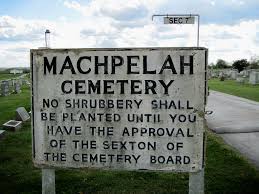
“Abraham buried Sarah his wife in the cave
of the field of Machpelah…in the land of Canaan
Genesis 23:19
The verse above comes from a chapter that tells of the death of Sarah, the wife of Abraham, at the age of 127. “Abraham went in to mourn for Sarah and to weep for her” the author of Genesis said. Of course, he did. We don’t know how long they were married, but given their advanced ages it’s not a stretch to imagine they had been husband and wife for a century.
Whatever the duration of their union, Abraham grieved, but had no place to bury Sarah so he goes to a gathering of Hittite men near the city gate and says, “I am a stranger and an alien residing among you; give me property among you for a burying place, so that I may bury my dead out of my sight.” One of the men replies, “Bury your dead in the choicest of our burial places; none of us will withhold from you any burial ground.” Abraham apparently has a place in mind, a cave called Machpelah, but it belonged to a man named Ephron who is close by and hears the request. Thus a public negotiation between the two men begins. Abraham agrees to the price—which as best I can tell is about $2200 in today’s money—and the deal is closed.
The final resting place of Sarah is found today in Hebron, a Palestinian city, in a mosque called the Tomb of the Patriarchs. Abraham is also buried there as is their son Isaac and his wife Rebekah, grandson Jacob and his wife Leah. It has various crypts, which perhaps are the caves our text describes, but in either case is believed to be the land purchased by Abraham long ago.
Thus, from a theological standpoint, that passage reveals yet again how God fulfills his promises. God had vowed years before that the Promised Land would come to Abraham and his family. This passage tells of the first piece of real estate to honor that divine commitment. The scene also offers an answer to any trivia question that asks for the name of the first cemetery in the Bible.
Yet what struck me in that scene was neither theological or trivial, but rather a very practical matter; namely how Sarah was 127 years old and Abraham a decade older, but that the couple had made no plans for their final resting place. We don’t know if they had ever talked about it, but even if they had nothing had occurred toward finalizing a plan. Thus, in a time of grief, that husband and father of a great nation had to begin making final arrangements for his life’s partner. Certainly, he was not the last person to find himself in such a situation.
One day, years ago, I went to visit a retired schoolteacher in the congregation named Clara. She had been on my first Session and was a beloved part of that church. Each Christmas, she would treat Lori and me to some homemade bourbon balls. Every time she would present the candy by saying “Oh, these aren’t very strong,” and every time we realized after one bite that we had a different definition of “strong”! Clara never married nor did she move from the house where she had grown-up. Her two older brothers and she shared that residence all their days. Both of them were life-long bachelors and died before I arrived in the community.
Clara had asked me to stop by and when I arrived learned that she wanted to talk with me about how she might remember the church in her will. While I don’t recall the details of our conversation, I do know that upon her death a decade or so later, a bequest did come from her estate that continues to bless the music ministry of that congregation. Once Clara and I had finished that discussion and I had thanked her for such generosity, we moved to a related topic. “Have you given any thought to your funeral?” I asked. “Oh, no,” she said. “I had to plan the funeral for both of my brothers and our parents. Someone else is going to have to plan my service.”
I gently mentioned how she had no immediate heirs. “Don’t you think it would help to offer your own thoughts so that they would know your wishes?” “That’s not going to happen,” Clara replied. I was no longer her pastor when that day arrived so I can’t speak first-hand to who made the choices for the service that honored her life and witness. I suspect it was her minister.
Yet what I can tell you is there were innumerable times over my career as a pastor when loved ones gathered to speak with me about an upcoming funeral, but didn’t have the same view as to what it should look like. One adult child wants it at the funeral home and another at the church. The spouse didn’t want anyone other than me to speak at the service, but the deceased’s cousin was insistent he should offer extensive remarks, too. I was never present when families made arrangements at a funeral home. Yet I have heard of times when there were passionate disagreements as to the kind of casket or headstone, cremation or burial, what clothes to use or where to designate memorial gifts for their loved one. Emotions are always heightened when a life ends, but without those earlier conversations the decisions to be made can be more complicated and persons vulnerable to choices that may not have been their loved one’s wishes.
I certainly understand why we humans avoid the issue as it is a reminder of our own mortality. It can be perceived as our giving up hope and even raising the topic can make others uncomfortable. There are times when death comes far too soon, too, long before one anticipated the need for such a conversation.
I get all the reasons such conversations don’t happen, but would contend that having such a talk with loved ones or writing out one’s wishes is a gift. It’s a gift to those left behind in that it permits them in the time of our passing to focus on their grief and not on some other decisions that have to be made in those first hours. It’s a gift in that it provides a clear expression of our own preferences permitting those left behind to know what we wanted. It’s a gift and even though it hasn’t happened often enough in my experience, when it has taken place, the blessing to loved ones is palpable.
If you have not begun that conversation with your spouse or adult children, parents or 80 year old bachelor cousin, I encourage you to start. Not everyone is ready and perhaps that will be true in your case, too. At the very least, if you have not done so, start thinking about what you would want for yourself as it will be a blessing to those left behind. One that hopefully will not be needed for years, but a gift to those who remain, even as we enter the eternal place already prepared for us.
Eternal One, thank you for the strength you provide in difficult conversations. May that gift be just what is needed this day for me or someone I love. Amen.
12 responses to “A Place For Us”
Great photo and a wonderful story about an equally great woman.
To be sure!
Enjoyed this story…..Clara was a jewel and loved giving out those bourbon balls. I can attest that her bourbon balls were very strong.
I’m glad to know it wasn’t just me, Sandy! 🙂
My parents passed within a year of each other and I’m an only child. It was a true gift that they had made their wishes known and made arrangements prior. It made everything “easier” in a very difficult time!
I’m so glad they did that, Jenny!
A very good encouragement for folks to make final arrangements. My parents did. We have done so as well. With the caveat – “And if you want to do something different, that’s OK too. My hope is wherever I am, I will no longer worry about such things!!!”
Very true, Don!
She keeps on giving!!!
Planning is a gift!!! Something my parents did share with us!! We all were so grateful!
Grateful for you…
Good for them, Cyndy. It’s such a gift!
As others have said, my parents also left their wishes. Since they lived with me and coming from a very large family, all I had to say was “this is what they wanted” and the many opinions ceased. I will forever be grateful to them for that final gift. I have also done the same for my children. As a matter of fact, I’ll be meeting with my son this weekend for updates! Very important message, John.
I’m glad you had such good role models, Alice, and that you are following their example!